Carautonomy — car parts and warning lights explained

Guide · 6 min read

The spectrum of automotive powertrains

For most of the last century, buying a car meant choosing a colour, a body style, and maybe an engine size — the powertrain itself was a given. That's no longer true.

Today's shopper faces a genuine spectrum of options, each blending combustion and electricity in a different ratio. Understanding where each one sits on that spectrum is the key to picking the right vehicle for how you actually drive.
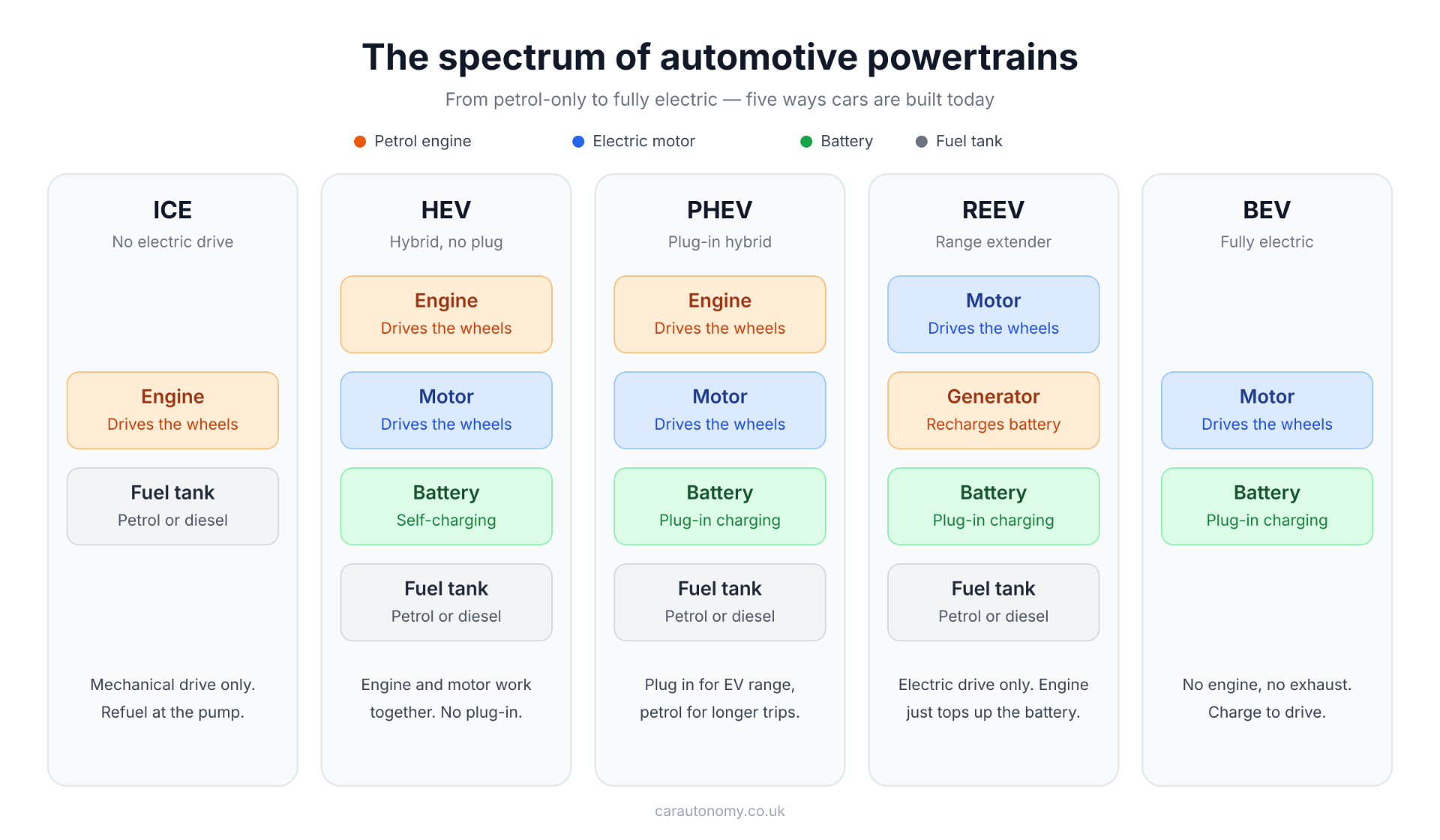
Diagram comparing ICE, HEV, PHEV, REEV and BEV car powertrains, showing which components each uses.

How we got here

The internal combustion engine (ICE) had the automotive world to itself for roughly a century, refined generation after generation but fundamentally unchanged in concept: burn fuel, turn a crankshaft, drive the wheels. Electrification entered the mainstream not as a replacement but as an assist — hybrids in the late 1990s and 2000s used small batteries and electric motors purely to make combustion engines more efficient, with no ability to plug in at all.

The next step was giving that battery somewhere to draw power from besides the engine itself. Plug-in hybrids arrived so drivers could complete short trips on electricity alone while keeping a petrol engine for longer journeys. From there, manufacturers began asking how far you could push the electric side before the engine became almost incidental — leading to range-extended EVs, where combustion no longer touches the wheels at all, only tops up the battery. And at the far end of the spectrum, battery electric vehicles remove combustion entirely, betting everything on battery capacity and charging infrastructure.

Five distinct architectures have emerged from this progression, each representing a different balance of electric range, fuelling convenience, and mechanical complexity.

The five powertrain types

Internal Combustion Engine (ICE)

The traditional setup: a combustion engine mechanically connected to the wheels, refuelled at a petrol station. No battery, no motor, no plug. This is still the baseline against which every alternative is measured.

Hybrid Electric Vehicle (HEV)

An HEV pairs a combustion engine with an electric motor and a small battery, but the battery only charges itself through regenerative braking and the engine — there's no plug. The engine and motor work together, with the electric side smoothing out inefficiencies and enabling things like engine shut-off at traffic lights. Think of the Toyota Prius as the archetype.

Plug-in Hybrid Electric Vehicle (PHEV)

A PHEV takes the HEV concept and adds an external charging port and a larger battery, big enough to drive on electricity alone for a meaningful distance — typically 20 to 40 miles — before the petrol engine takes over for longer trips. It's the "best of both" option for drivers who can charge at home but still want a petrol engine for longer journeys.

Range-Extended Electric Vehicle (REEV/EREV)

This is where the architecture flips. In a REEV, the electric motor is the only thing physically connected to the wheels — the combustion engine never drives them directly. Instead, the engine acts purely as an onboard generator, recharging the battery when it runs low. REEVs require both charging and fuelling to get full use out of them, but they drive like an EV all the time.

Battery Electric Vehicle (BEV)

No engine, no fuel tank, no exhaust. A BEV relies entirely on a large battery pack and an electric motor, refuelled exclusively by plugging in. It's the simplest drivetrain of the five, mechanically speaking, even though it demands the most from battery technology and charging infrastructure.

Pros and cons at a glance

PowertrainHow it worksProsCons
ICECombustion engine mechanically drives the wheels; refuel with petrol or diesel onlyFast refuelling; mature, widely available service network; typically lowest purchase price; long driving rangeLowest fuel efficiency; highest exhaust emissions; more moving parts to maintain over time
HEVEngine and motor work together; battery self-charges via regenerative braking; no plugBetter fuel economy than ICE with no change in habits; no charging infrastructure needed; strong resale familiarityLimited to no all-electric driving; battery is small, so efficiency gains are modest; still fully dependent on petrol
PHEVEngine and motor work together; battery charges from the grid or the engineElectric-only driving for daily commutes; petrol engine removes range anxiety on longer trips; can qualify for EV incentives in many regionsMore complex and costly than ICE/HEV; electric range is limited (usually under 40 miles); needs disciplined charging to realise efficiency gains
REEVMotor alone drives the wheels; engine only generates electricity to recharge the batterySmooth, consistent EV-like driving feel; petrol engine eliminates range anxiety without needing a charger nearby; simpler drive unit than a PHEVRequires both charging and fuelling for full function; less efficient than a BEV since energy converts from fuel to electricity to motion; fewer models currently available
BEVElectric motor alone drives the wheels; battery charged only via plug-inZero exhaust emissions; lowest running costs and mechanical complexity; strong acceleration and quiet rideFully dependent on charging infrastructure; longer refuelling ("charging") time than petrol; range can be affected by weather and driving conditions; typically highest upfront cost

Choosing where you fit on the spectrum

There's no universally "best" powertrain — only the best fit for a given driver. Someone doing long motorway hauls with no reliable charging access may still be best served by an ICE or HEV. A commuter with a home charger and occasional road trips is the classic PHEV or REEV buyer. And a driver who wants the lowest running costs, doesn't mind planning around charging stops, and is ready to go all-in on electric will find a BEV hard to beat.

The broader trend is unmistakable: each step along the spectrum shifts more of the driving experience onto electricity while chipping away at how much the combustion engine — if it's there at all — actually does. Where any one buyer should land on that spectrum still comes down to charging access, typical trip length, and budget.

Related reading